

About the Center
Who is involved with the Center?
Courageous wholeness is the experience of integrity that emerges when we confront our shadow and dedicate ourselves to serving something larger than ourselves.
How do you help people develop courageous wholeness?
We call our approach shadow-integrated servant leadership. This work weaves together two powerful concepts:
Servant Leadership
We develop leaders who are focused on supporting the growth and development of others, rather than on feeding their own hungers for power, wealth, and attention.
Shadow-Integrated
Connecting with our own deepest values and highest aspirations for how we want to be as leaders is neccesary but not sufficient. We must also courageously confront our own shadow—the parts of our selves that we deny and resist. When we integrate our shadow and learn to work skillfully with our wholeness, we begin calling forth wholeness in our lives and our organizations.
How do you do develop shadow-integrated servant leaders?
Over the course of decades, we’ve developed a powerful, proven and effective approach to developing these kinds of leaders. Our approach is grounded in two key concepts: The Dual Journey, and The Flame leadership development model.
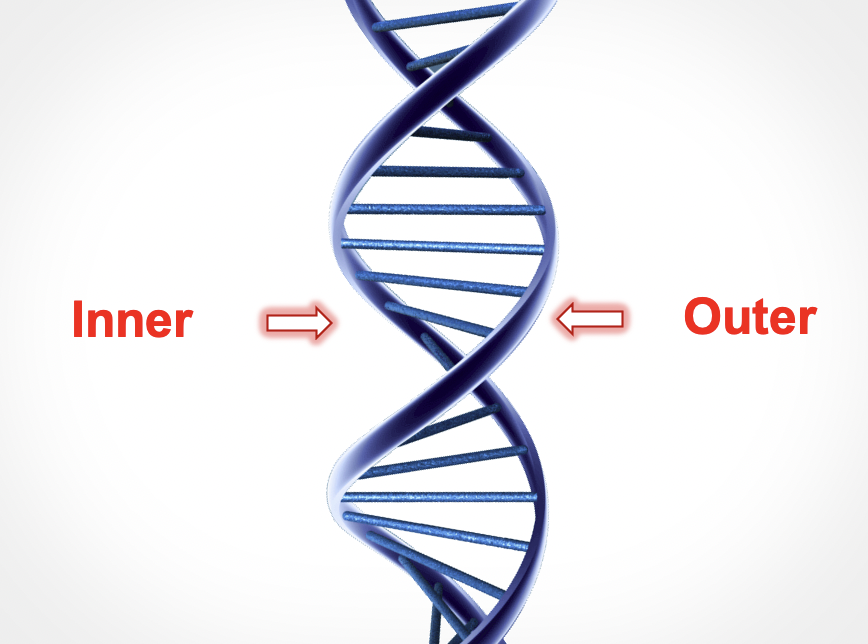
The Dual Journey is the belief that the processes of inner change and outer change are too interconnected to seperate.
When we focus on only one while neglecting the other, our efforts to create change are going to be limited and ineffective.
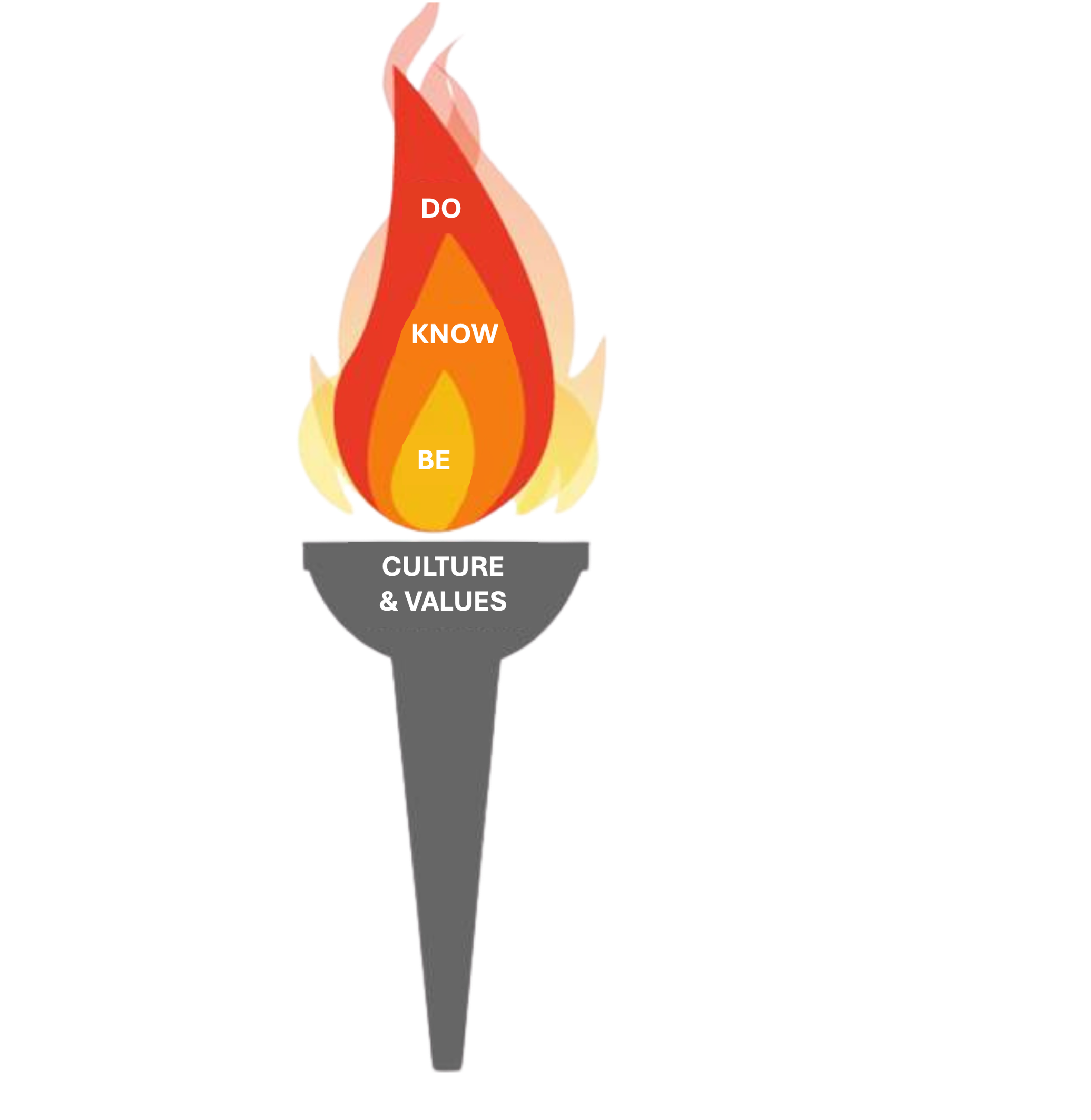
The Flame leadership development model clearly illuminates the relationship between the two dimensions of outer change (through our impact in the world) and inner change (what we know and how we are being). It also makes it clear that individual development always occurs within the context of a wider organiational culture that is animated by a particular set of values.
We believe that most organizations already operate with a focus on organizational culture as well as on the “Do” and “Know” elements of The Flame. Very few organizations focus on developing individuals at the innermost “Be” level of The Flame. Even fewer know how to engage large numbers of individuals in this inner development powerfully and at scale.
We want that to change.
How do you develop shadow-integrated servant leaders at scale?
While the work of developing individual leaders is one core competency of the Center for Courageous Wholeness, our expertise extends far beyond that. Organizations that aspire to make shadow-integrated servant leadership central to their approach to talent development need to build a new capacity to guide large numbers of staff through a powerful journey of inner development at the innermost “BE” level of the Flame.
This capacity is different from traditional approaches that focus on knowledge transfer, skill building, and competency development. This is about inviting individuals to engage in deep inner development in ways that are safe, powerful, calibrated to be effective in professional environments, and that operate alongside other organizational processes like performance management.
The challenge of doing shadow-integrated servant leadership development at scale are quite distinct from the challenges of developing individual leaders. Our approach to this work is explained in detail in the book Developing Servant Leaders at Scale: How to Do It and Why It Matters.
If you are interested in exploring what it would take to bring this work to your organization, please reach out. We would love to connect!
What are the intellectual foundations of this work?
The approach developed by the Center for Courageous Wholeness weaves together several theoretical lineages. Here’s a high-level overview of the thought leaders whose work is integral to the Center’s approach::
Ron Heifetz: Over the course of 40 years of teaching at the Harvard Kennedy School, Ron Heifetz has developed and refined the Adaptive Leadership model. It is one of the most influential theories of leadership in the realm of civic leadership development across the globe. The Founder of the Center, Dr. Max Klau, has a doctorate grounded in adaptive leadership, and this framework is the conceptual foundation for the approach developed by the Center.
Margaret Wheatley: Wheatley’s seminal work Leadership and the New Science has had a profound influence on this approach. She offers a powerful analysis of how recent discoveries in fields like chaos theory and complex systems theory have profound implications for the way we think about and practice leadership.
Joseph Campbell: Campbell was a comparative mythologist who studied myths and stories told around the world. His ideas about the hero’s journey and the connection between myth, psyche, and spiritual development are foundational to the Center’s work.
Ken Wilbur: Wilbur is the founder of Integral Theory, a comprehensive framework for understanding human development that weaves together a wealth of concepts and frameworks from East and West. Dr. Max Klau is trained as an Integral Master Coach, and Wilbur’s work on Integral Theory is another perspective that is foundational to this work.
The work of the center also draws on a great many other intellectual lineages, including those of Peter Senge, Otto Scharmer, Jim Collins, Bob Kegan, and many, many others. But the four lineages highlighted here form the foundations upon which this work was built.